Part ML
Regulation 1321/2014
Annex Vb
Part CAO
Regulation 1321/2014
Annex Vd
Acceptable Means of Compliance and Guidance Material to Part ML
(FR: Programme d’entretien en français)
First, you must differentiate the Aircraft Maintenance Programme (AMP) from the Aircraft Maintenance Manual (AMM).
The Aircraft Maintenance Manual (AMM) is a document written by the aircraft maker (or DAH which means Design Approval Holder), listing (at the time of the delivery) all the maintenance actions, procedures and schedules. The AMM is a huge document (1000 pages +), extremely detailed by the engineers who developped the aircraft. Though, it is not sufficient to take care of an aircraft, for two reasons:
- first, during the life of an aircraft, weaknesses can appear in the conception or some parts (or selective batches of parts), requiring the authority to publish and mandate an emergency corrective action: an Airworthiness Directive (AD). AD must be taken into account immediately, and be incorporated in the AMP. Later, a new revision of the AMM, released by the DAH, may incoporate the AD action.
- second, your aircraft may receive modifications during its life, by the addition of equipments, reparations, new avionics, different engine or propeller… How the modifications are applied will be discussed here. All those modifications will usually come with new maintenance actions, also called Instructions for Continuying Airworthiness (ICA). Those ICA will have to be incorportated in the AMP.
The bottom line, is that the AMP will give a complete view of the aircraft state and maintenance “score”, including all the data that the aircraft maker could not be aware at the time of delivery.
Another significant point is that, with the new Part ML regulation, it is possible to deviate from the Aircraft Maintenance Manual, by an inch (subtle deviations) or a yard (Minimum Inspection Programme). This is totally new, as, before 2020, all the AMM instructions and ICAs were to be applied. To the letter.
Now, two main choices are offered in the Part ML regulation, whether the aircraft owner endorses the airworthiness reponsability, or chooses to pay a workshop – Part CAO – to do it.
- sticking to the AMM while introducing some deviations, which will have to be listed, and eventually compensated. All deviations are permitted, as long as they are not less restrictive than the MIP (below) and not enforcing an Airworthiness Directives (AD) or Airworthiness Limitations (ALI). The deviations do not have to be approved, they are to be declared.
- leaving the AMM away, and go for the generic Minimum Inspection Programme (MIP), which is the same for all lights aircrafts, and proposed by the EASA. The MIP will not take into account any specificity of your aircraft, that’s why it is not the best option.
How do I write my own Maintenance Programme ?
You will be helped by the very detailed guide published by the EASA, chapter ML.A.302 (page 9 to 19).
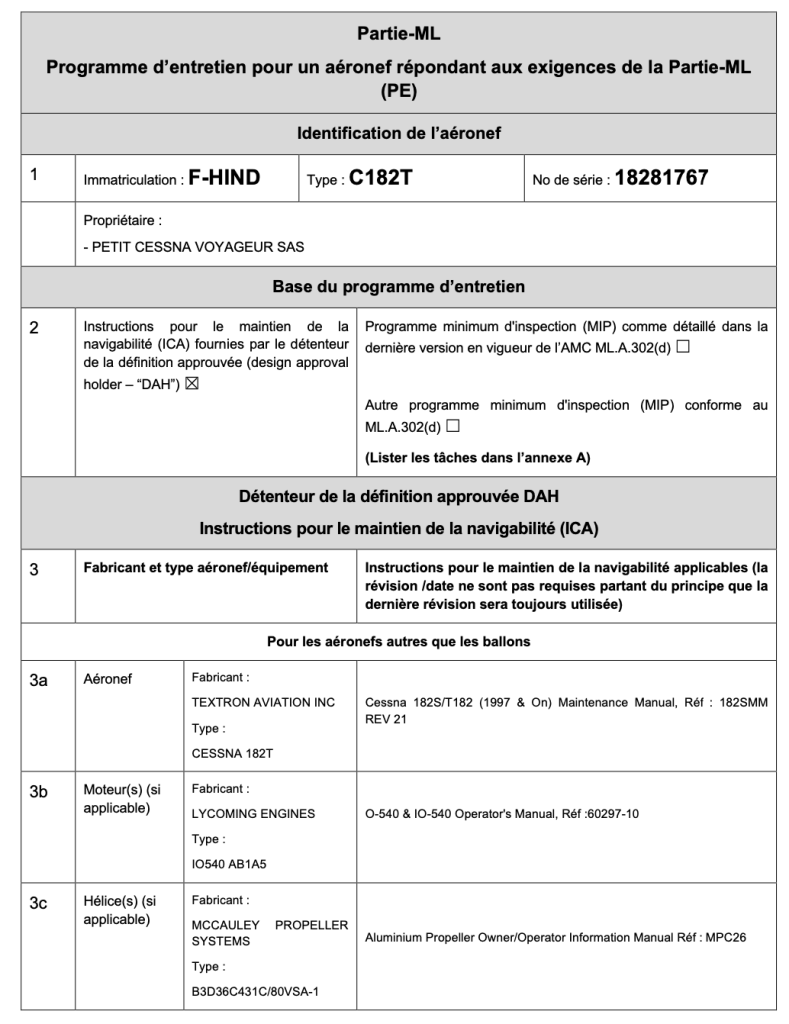
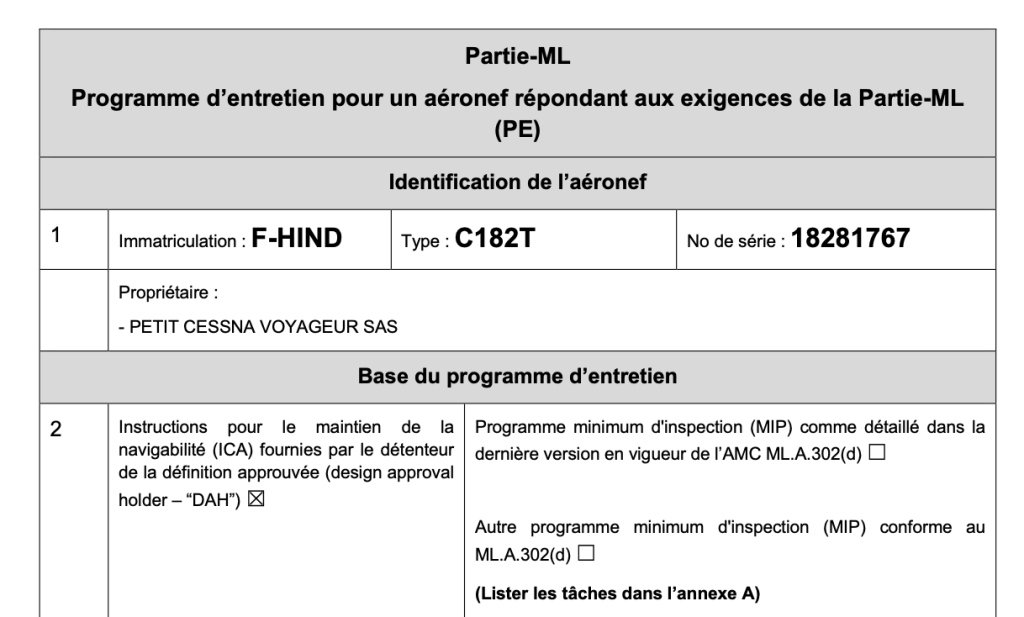
On the first page, you will fill registration, type, serial number and aircraft owner (as written on the Registration Certificate). Then take an option for the basis of the programme: either the AMM or the MIP (options 1 or 2 above). Then, you will write down the maintenance manuals, with revisions, for the aircraft, engine and propeller.
On page 2, you will feed more informations for your AMP, in order to define the scope of data which will be used to build the score:
- Has your aircraft undergone modifications (new equipment, reparations) implying supplemental maintenance actions ?
- Are there Airworthiness Limitations (ALI), which can be found in the Chapter 4 of the Aircraft Maintenance Manual (AMM) or in the Type Certifcate Data Sheet (TCDS) ?
- Are there overhaul time recommandations, such as found in Service Bulletin (SB) ? They are to be distinguised from Airworthiness Directive (AD) as they are not mandatory, though, must be detailed.
- Are there Airworthiness Directives applicable to the aircraft ?

Then you will state if the owner (or some of the owners) performs maintenance actions on their own. If the aircraft is owned by a company, this is not allowed.
Later, you will have to declare the person reponsible for the airworthiness and certify that the aircraft will be maintened according to the AMP.
Then, come 4 annexes.
Annex A is the MIP; disregard if you work with the AMM.
Annex B is where you list additional maintenance actions, relative to what was listed in page 2 (modifications, reparations, ALI, AD, applicable SB).
Annex C is very important. This is were you list the deviations from the Maintenance Manual. As said before, you are free to introduce them as long as they are not inforcing an AD or ALI or less restrictive than the MIP. They are declared and not approved. For each deviation, you will have to fill a form justifying the deviation and eventually add compensating action.
Annex D is for additional information (type of flights, corrosive environnement…)

At last, you have three guides:
- Guide 1: it is the annual review procedure. By answering the questions, you should be able to know if the AMP is well fitted of if it needs to be updated.
- Guide 2: it is where you list the revisions of the AMP.
- Guide 3: it is the form used to assess every deviation introduced in the AMP
And you’re done !
Keep in mind: by the AMP, you certify what you do with the aircraft maintenance. If for whatever reason, you want or need to do differently: amend your AMP. If you missed a scheduled operation ? Amend your AMP (if not a missed AD or ALI !).
It is just a declaration. You don’t have to communicate the revision to the administration.
In case of mismatch, your aircraft is unairworthy. So you have to acquire the discipline, to keep aircraft maintenance and AMP in good harmony.
How to write and declare an Aircraft Maintenance Programme (AMP)
 Aeropages